
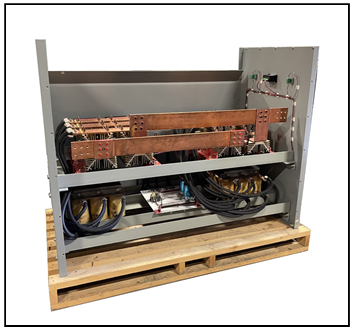
Transformer rectifier assemblies (TRAs) are essential components in various electrical systems, particularly in applications where a stable direct current (DC) power supply is required. They are commonly used in industries such as aviation, telecommunications, railways, and more. A TRA typically consists of two main components: a transformer and a rectifier.
1. Transformer: The transformer in a TRA serves several purposes:
-
Voltage Transformation: The primary function of the transformer is to transform the incoming alternating current (AC) voltage to a different voltage level. This is achieved through the turns ratio of the transformer windings. The secondary winding of the transformer provides the desired output voltage.
-
Isolation: Transformers provide electrical isolation between the input and output sides. This isolation can help protect equipment and personnel from electrical hazards and reduce noise and interference in the system.
-
Impedance Matching: In some cases, transformers are used for impedance matching between the input and output of the rectifier, ensuring efficient power transfer.
2. Rectifier: The rectifier in a TRA converts the alternating current (AC) from the transformer’s secondary winding into direct current (DC). Typically, this is done using diodes, and the most common configuration is a bridge rectifier as described in the previous answer. The rectifier serves the following functions:
-
Conversion: The rectifier converts the AC voltage to DC by allowing current flow in only one direction, effectively removing the negative half of the AC waveform.
-
Smoothing: The resulting DC voltage may still have some ripple or fluctuations. Filtering components like capacitors are often added to smooth the output and provide a more stable DC voltage.
Additional Components and Features:
In addition to the transformer and rectifier, TRAs may include various components and features depending on the specific application:
-
Filtering Capacitors: As mentioned, capacitors are often used to reduce voltage ripple and stabilize the DC output.
-
Voltage Regulation: Some TRAs may incorporate voltage regulation circuits to maintain a constant output voltage even when the input voltage varies.
-
Control and Monitoring: For more advanced applications, TRAs may include control and monitoring systems that allow for remote operation, voltage adjustment, and fault detection.
-
Cooling Systems: In high-power applications, cooling systems such as fans or heat sinks may be integrated to dissipate heat generated during operation.
-
Protection Circuitry: TRAs may also have protection features such as overcurrent protection, overvoltage protection, and short-circuit protection to ensure the safety and reliability of the system.
Transformer rectifier assemblies are crucial in various industrial and commercial settings where a stable and reliable source of direct current is required. They are customized based on the specific voltage and current requirements of the application and play a fundamental role in the functioning of many electrical systems.
CONTACT FOR A FREE QUOTE
Our SCR Diode Testers have been used in the industry for over 40 years.
Our engineers can respond within the hour.
EMAIL: quote@cehco.com
PHONE: (714) 624-4740
CARL E. HOLMES COMPANY
MANUFACTURER OF CUSTOM DESIGNED DC RECTIFIERS UP TO 100 KW, TRANSFORMER RECTIFIER ASSEMBLIES, POWER SUPPLIES, AND SELENIUM RECTIFIERS AND SUPRESSORS
OUR SCR DIODE TESTERS HAVE BEEN USED IN THE INDUSTRY FOR OVER 40 YEARS
RECTIFIER SPECIALIST SINCE 1945
L/C MAGNETICS INC.
MANFACTURER OF DRY TYPE AND OIL FILLED CUSTOM DESIGNED TRANSFORMERS, CURRENT LIMITING REACTORS, AND INDUCTORS FROM 0.1 KVA TO 50 MVA
OFFERING DRY TYPE GENERAL PURPOSE TRANSFORMERS FROM 15 KVA TO 2500 KVA, ALUMINUM WOUND AT AN ATTRACTIVE PRICE
CELEBRATING 35 YEARS IN BUSINESS