
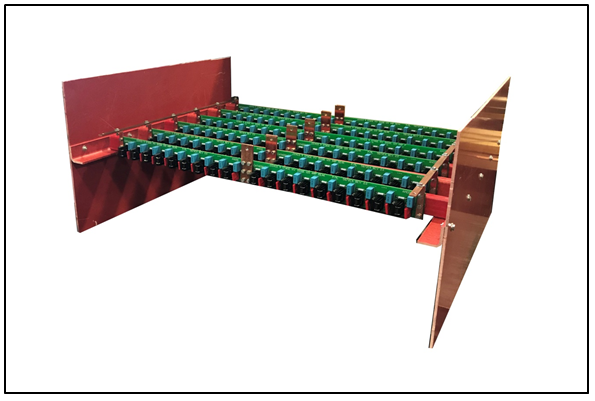
A 12-pulse diode bridge rectifier is an electrical circuit that converts alternating current (AC) input into direct current (DC) output with reduced harmonic distortion. It is a specialized rectifier configuration used to supply a cleaner and more stable DC voltage in high-power applications. The term “12-pulse” refers to the fact that this rectifier design utilizes two separate six-pulse diode bridge rectifiers operating in parallel but with a 30-degree phase shift between them. Here are the key features and components of a 12-pulse diode bridge rectifier:
-
Diode Bridge Rectifiers: Two six-pulse diode bridge rectifiers are used, each consisting of six diodes arranged in a bridge configuration. These diodes allow current to flow in only one direction, effectively converting the AC voltage to a pulsating DC voltage.
-
Phase-Shifting Transformers: A pair of phase-shifting transformers is used in the system to introduce a 30-degree phase shift between the input currents of the two diode bridge rectifiers. This phase shift is crucial for reducing harmonic distortion in the input current waveform.
-
AC Input: The 12-pulse diode bridge rectifier is connected to the AC input, typically through a delta-wye (Δ-Y) transformer connection. The input voltage is stepped down or up as needed by the transformer.
-
Filtering Components: After rectification, the pulsating DC voltage is smoothed using filtering components such as capacitors and inductors to reduce ripple and provide a more stable DC output.
-
Load: The load, which can be a motor, drive, or other high-power device, is connected to the output of the rectifier to receive the DC power supply.
Key Benefits and Applications:
-
Reduced Harmonic Distortion: This type of rectifier configuration significantly reduces harmonic distortion in the input current compared to standard six-pulse rectifiers. This is important for applications where minimizing harmonic interference on the power grid is essential.
-
High Power Applications: This rectifier is commonly used in high-power industrial applications, such as motor drives, variable frequency drives, and industrial processes requiring precise and low-distortion DC voltage.
-
Power Quality Improvement: It improves power quality by reducing harmonics, which can cause voltage waveform distortion and affect other connected equipment.
-
Adjustable Output: Depending on the specific application, the DC voltage output of the rectifier can often be adjusted by controlling the transformer tap settings or by using voltage regulation methods.
-
Industrial Motor Control: The 12-pulse diode bridge rectifier is frequently used in motor control applications to provide a clean and stable DC supply for driving industrial motors, ensuring smooth and efficient operation.
It’s worth noting that while the 12-pulse diode bridge rectifier configuration offers advantages in reducing harmonics and improving power quality, it also requires additional components, including phase-shifting transformers, which can increase the complexity and cost of the system compared to standard rectifiers. Consequently, its use is typically reserved for high-power applications where harmonic distortion reduction is critical.
CONTACT FOR A FREE QUOTE
Our SCR Diode Testers have been used in the industry for over 40 years.
Our engineers can respond within the hour.
EMAIL: quote@cehco.com
PHONE: (714) 624-4740
CARL E. HOLMES COMPANY
MANUFACTURER OF CUSTOM DESIGNED DC RECTIFIERS UP TO 100 KW, TRANSFORMER RECTIFIER ASSEMBLIES, POWER SUPPLIES, AND SELENIUM RECTIFIERS AND SUPRESSORS
OUR SCR DIODE TESTERS HAVE BEEN USED IN THE INDUSTRY FOR OVER 40 YEARS
RECTIFIER SPECIALIST SINCE 1945
L/C MAGNETICS INC.
MANFACTURER OF DRY TYPE AND OIL FILLED CUSTOM DESIGNED TRANSFORMERS, CURRENT LIMITING REACTORS, AND INDUCTORS FROM 0.1 KVA TO 50 MVA
OFFERING DRY TYPE GENERAL PURPOSE TRANSFORMERS FROM 15 KVA TO 2500 KVA, ALUMINUM WOUND AT AN ATTRACTIVE PRICE
CELEBRATING 35 YEARS IN BUSINESS